
Victoria’s Property Sale Laws Have Changed: Key Reforms and Commencement Dates
In August 2026, we wrote about the proposed changes to Victorian property sales under the Consumer Legislation Amendment Bill 2026, including significant changes to Section 32 Vendor Statements and the early release of deposits.
At that time, the Bill had not yet completed Parliament.
That position has now changed.
The Consumer Legislation Amendment Act 2026 (Vic) received Royal Assent on 8 September 2026. The reforms are therefore now law, although importantly, they do not all commence at the same time.
Some of the changes affecting residential property advertising and price disclosure commenced on 1 October 2026, while significant changes to Section 32 Vendor Statements and the release of deposits will commence progressively during 2027.
When do the changes commence?
The key commencement dates are:
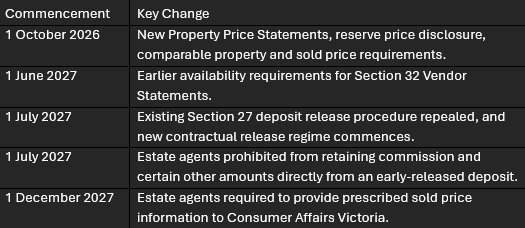
For auctions and fixed-date sales, some of the new requirements introduced from 1 October 2026 apply to auctions and fixed-date sales held on or after 16 October 2026.
Changes from 1 October 2026 – greater price transparency
A number of reforms directed at residential property sales and underquoting have already commenced. These changes principally regulate estate agents and include the replacement of the existing Statement of Information with a new Property Price Statement.
The Property Price Statement must contain additional information about the property being sold and the comparable properties relied upon in determining the estimated selling price. It must also be displayed prominently in online advertising rather than being difficult to locate within a property listing.
The comparable property requirements have also been strengthened. Where three comparable properties cannot be identified but one or two appropriate comparable sales exist, those properties must now be taken into account and disclosed.
These reforms apply to residential property sales. The Victorian underquoting regime does not apply in the same way to commercial, industrial or rural property sales, although general obligations concerning misleading or deceptive conduct continue to apply.
Reserve prices must now be disclosed before auction
One of the more significant changes for residential auctions and fixed-date sales is the requirement for the vendor's reserve price to be publicly disclosed.
An estate agent must request the vendor's reserve price in writing and publish it at least seven days before the auction or fixed-date sale. If the reserve price has not been published within the required timeframe, the auction or fixed-date sale cannot proceed as scheduled.
The reserve must be expressed as a single dollar amount and cannot be qualified by expressions such as "from", "over", "starting at" or "+".
Advertising and marketing material must also be updated to reflect the reserve price.
For auctions and fixed-date sales, these requirements apply to sales held on or after 16 October 2026.
Sold prices must be published
Estate agents are also now required to update the Property Price Statement to disclose the property's sold price within seven days after the sale becomes unconditional.
The updated Property Price Statement must generally remain publicly available for at least 18 months.
There are limited exemptions, including circumstances involving family violence or personal violence, where an exemption has been obtained from the Director of Consumer Affairs Victoria.
These requirements apply to sales becoming unconditional on or after 1 October 2026, even where the Contract of Sale was signed before that date, subject to applicable transitional exceptions.
Changes from 1 June 2027 – Section 32 Vendor Statements must be available earlier
The next significant stage of the reforms commences on 1 June 2027 and changes when a Section 32 Vendor Statement must be available to prospective purchasers.
Presently, the central requirement is that the Vendor Statement be provided before the purchaser signs the Contract of Sale.
From 1 June 2027, the timing will depend upon how the property is being sold.
For a publicly advertised private sale, the Section 32 Vendor Statement must generally be available no later than 14 days after the property is first publicly advertised.
For an auction or fixed-date sale, it must generally be available at least 14 days before the first auction or fixed date.
Where a property is not publicly advertised, the Vendor Statement must be available before the purchaser signs the Contract of Sale.
There are also exceptions allowing a property to be sold earlier. For example, if a private sale property is sold within the first 14 days after advertising begins, the parties do not need to wait until the end of that period before entering into a contract. The Vendor Statement must instead be available before the purchaser signs. Similar provision is made where a property intended for auction or fixed-date sale is sold sufficiently early before that date.
There is no mandatory 14-day waiting period before a property can be sold
This remains an important distinction.
The new law does not impose a blanket requirement that every purchaser must have a Section 32 Vendor Statement for 14 days before signing a contract.
Rather, the reforms require the Vendor Statement to be prepared and made available earlier during the sale and marketing process, while preserving the ability for a vendor to accept an early offer provided the applicable requirements are satisfied.
In practice, however, vendors intending to sell by auction will need to instruct their lawyer or conveyancer substantially earlier so that the Contract of Sale and Vendor Statement are ready before the statutory deadline.
Changes to a Vendor Statement must also be notified
From commencement of the new Section 32 regime, a vendor will also be required to give a purchaser written notice of any changes to the Vendor Statement before the purchaser signs the Contract of Sale.
This is particularly relevant where a property remains on the market for an extended period and information contained in or attached to the Vendor Statement changes during the campaign.
It will place greater importance on communication between vendors, estate agents and the vendor's lawyer or conveyancer, as well as careful document management and version control.
The new timing requirements are substantive statutory obligations. Failure to make a compliant Section 32 Vendor Statement available within the required timeframe may give rise to a purchaser's statutory rights of rescission and may also expose the vendor to statutory penalties.
There is a transitional provision under which the new Section 32 requirements will not apply to contracts entered into within 28 days after commencement of the new regime.
Changes from 1 July 2027 – Section 27 deposit releases will disappear
A further significant change concerns the early release of deposits.
The Act provides for the repeal of the familiar Section 27 early release of deposit procedure under the Sale of Land Act 1962. Although the change has now been legislated, the existing Section 27 process remains in operation until the new regime commences.
Consumer Affairs Victoria states that the new regime will commence on 1 July 2027.
Under the new Section 26A, where a lawyer, conveyancer or estate agent holds the deposit as stakeholder, the deposit cannot be released to the vendor, or as the vendor directs, before settlement unless the Contract of Sale contains a condition agreed between the purchaser and vendor permitting the early release of the deposit.
This represents an important change in approach.
Under the existing Section 27 procedure, a vendor may seek early release of the deposit after the Contract of Sale has been entered into by following the statutory process. Under the new regime, the ability to obtain early release will instead depend upon the terms of the Contract of Sale agreed between the parties.
For vendors who may require access to the deposit before settlement, this issue will therefore need to be considered when the Contract of Sale is prepared and negotiated.
What happens to an estate agent's commission?
The Act also introduces a new Section 26B which, from 1 July 2027, will prevent an estate agent from retaining its commission, auction expenses or other amounts to which it is or will become entitled from an early-released deposit before settlement or rescission of the contract.
The restriction is directed specifically at the use of the deposit monies themselves. It does not prevent an estate agent from receiving its commission, auction expenses or other entitlements directly from the vendor from separate funds before settlement or rescission.
In practice, this may lead estate agents to review the payment provisions in their sale authorities and consider whether commission or other amounts should become payable by the vendor from separate funds before settlement.
Whether this develops into standard industry practice remains to be seen.
Changes from 1 December 2027 – further sold price reporting
The final major commencement date under the property sale reforms is 1 December 2027.
From that date, estate agents will also be required to provide prescribed sold price information to the Director of Consumer Affairs Victoria, unless an applicable exemption has been granted.
This forms part of the broader policy objective of making Victorian property price information more transparent and readily available.
What should vendors and agents do now?
Although some of the most significant Sale of Land Act changes do not commence until 2027, vendors and property professionals should start considering how the reforms will affect the preparation and conduct of future sales.
For sales commencing in 2027, particular attention should be given to the timing of the sale campaign, proposed auction or fixed-sale date, preparation and updating of the Section 32 Vendor Statement, and whether the Contract of Sale should contain an appropriate early deposit release provision.
Estate agents should also review their sale authorities and internal processes well before 1 July 2027 to determine how the changes to early-released deposits may affect the timing and payment of commission.
The broader effect of the reforms is clear: property sale documentation, pricing information and contractual arrangements will increasingly need to be considered earlier in the sale process.
How KCT Legal can assist
KCT Legal advises vendors, purchasers, investors and property professionals in relation to Victorian property transactions, including the preparation and review of Contracts of Sale and Section 32 Vendor Statements.
For vendors contemplating a sale, early legal involvement can assist in ensuring that sale documentation is prepared within the applicable statutory timeframe and that important matters such as deposit release are addressed before the property is offered for sale.
This article is current as at 7 October 2026 and provides general information only. It does not constitute legal advice.