
Dying Without a Will in Victoria in 2026: The Statutory Legacy Has Increased Again
From 1 July 2026, Victoria's statutory legacy has increased to $591,390.00.
The figure is relevant when a person dies without a valid Will in particular family circumstances, especially where the deceased leaves a partner and children from a previous relationship.
It provides a timely reminder that dying without a Will does not mean that a person’s family can simply decide among themselves how the estate should be distributed. Instead, Victorian intestacy legislation determines who receives the estate and in what proportions.
What is the statutory legacy?
The statutory legacy is an amount determined under the Administration and Probate Act 1958 (Vic).
It becomes relevant where a deceased person dies intestate leaving a partner and a child or other issue who is not also the child or issue of that surviving partner.
The statutory legacy is therefore particularly relevant to blended families.
It is not an additional payment made by the government and it does not apply to every deceased estate.
How has the statutory legacy changed?
The amount is indexed periodically and the applicable figure depends upon the deceased’s date of death.
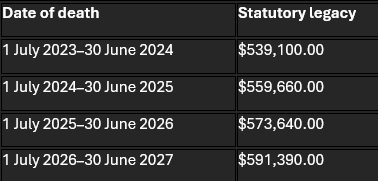
The statutory legacy has therefore increased by $52,290.00, or approximately 9.7%, since the 2023–24 financial year.
Why does it matter for blended families?
Consider a person who dies without a Will and leaves:
a spouse or domestic partner; and
a child from an earlier relationship.
If the residuary estate exceeds the statutory legacy, the surviving partner is generally entitled to the deceased's personal chattels, the statutory legacy together with the applicable interest, and one half of the balance of the residuary estate. The deceased's relevant children or other issue share in the remaining portion in accordance with the intestacy provisions.
For example, assume for simplicity that the residuary estate is $1.5 million and there is one surviving partner and one adult child from an earlier relationship.
Ignoring interest and personal chattels for the purpose of this simplified example:
the partner first receives the current statutory legacy of $591,390.00;
$908,610.00 remains;
one half of that balance, being $454,305.00, is added to the partner's entitlement; and
the remaining $454,305.00 is available for the child under the intestacy provisions.
The partner's monetary entitlement in this simplified example would therefore be approximately $1,045,695 plus applicable interest, in addition to the relevant personal chattels.
Different rules can apply where there is more than one surviving partner or where children have predeceased the deceased leaving their own issue.
What if all of the children are children of the surviving partner?
The statutory legacy should not be confused with the general rules governing every intestate estate.
Its significance arises particularly where the deceased has children or other issue who are not also children or issue of the surviving partner. Family structures therefore matter.
This is one reason why intestacy can produce results quite different from what a person may have assumed would occur.
A Will allows you to make the decision
The intestacy provisions are ultimately a default statutory regime.
They do not know:
which family members you are close to;
whether one child has already received substantial financial assistance;
whether a vulnerable beneficiary requires protection;
whether assets should be held through a testamentary trust;
whether a particular property should be retained or sold;
who you consider suitable to administer your affairs; or
how you would like competing family interests to be balanced.
These matters can instead be addressed through a properly prepared Will and broader estate plan.
For blended families in particular, careful planning can also reduce uncertainty and the potential for disputes between a surviving partner and children from earlier relationships.
When should your Will be reviewed?
A Will should be reviewed periodically and particularly following significant changes, such as marriage, separation or divorce, the commencement of a new relationship, the birth of children or grandchildren, acquisition or disposal of substantial assets, changes to business or trust structures or significant changes in family circumstances.
The increase in Victoria's statutory legacy to $591,390.00 provides another useful reminder: if you do not determine how your estate should pass, the law will do it for you.
KCT Legal can assist with Wills, testamentary trusts, estate planning and deceased estate matters, including estate planning for blended families and complex asset structures.
This article is provided for general information only and does not constitute legal advice. The information may not be appropriate for your particular circumstances. You should obtain specific legal advice before acting or relying on any information contained in this article.