
Victorian Probate Fees in 2026: What Executors and Estate Owners Need to Know
The cost of obtaining probate in Victoria has changed significantly in recent years.
While Probate Office filing fees were previously relatively modest, substantial changes introduced in November 2024 by the Victorian Labour Government created a new tiered fee structure based on the gross value of Victorian assets forming part of a deceased estate. Those fees have since been subject to annual increases.
From 1 July 2026, an estate with Victorian assets of $7 million or more may attract a Probate Office filing fee of $17,770.80.
For executors, beneficiaries and those undertaking estate planning, the changes make it increasingly important to understand which assets will form part of the estate and whether a grant of probate is likely to be required.
How much are Victorian probate fees?
The filing fee for an application for a grant of probate or letters of administration is calculated by reference to the gross value of the deceased's Victorian assets, rather than the net value of the estate after liabilities.
The extent of the increase becomes particularly clear when the current fees are compared with those applying only a few years ago:
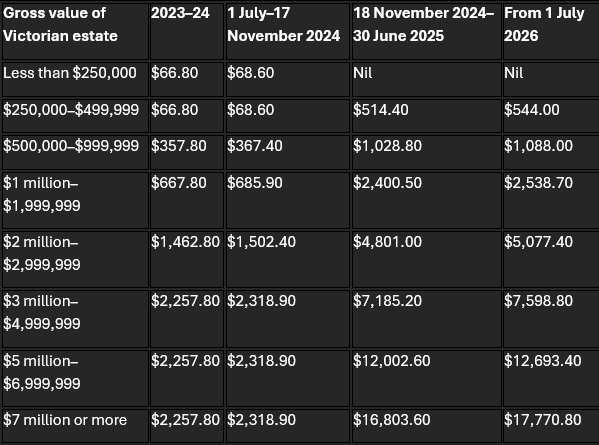
The 2023–24 figures were substantially lower, with the maximum filing fee then being $2,257.80 for an estate worth $3 million or more. The ordinary indexed fees increased modestly from 1 July 2024 before the Victorian Labour Government introduced an entirely new structure from 18 November 2024.
For an estate worth $7 million or more, the current filing fee is therefore almost eight times the fee that applied in 2023–24.
Why did the fees change?
The Victorian Labour Government reviewed the fees charged by the Probate Office in 2024. The resulting amendments introduced additional estate-value brackets and substantially higher fees for larger estates, while removing the filing fee for estates valued below $250,000.00.
The current fees continue to increase annually in accordance with the Victorian court-fee framework. The latest increase took effect on 1 July 2026.
Does every asset form part of the estate?
Not necessarily.
An important part of estate planning is understanding the distinction between assets personally owned by an individual and assets which may pass outside their estate.
For example, depending on the circumstances:
jointly owned property may pass to the surviving joint proprietor;
superannuation death benefits may be dealt with separately from the estate;
assets held by a trust are generally assets of the trust rather than assets personally owned by the deceased; and
assets owned by a company belong to the company, although shares owned personally by the deceased may form part of the estate.
Whether probate is required also depends on the nature of the assets held solely by the deceased and the requirements of the institutions holding those assets. There is no automatic requirement that probate be obtained in every estate.
Should probate fees change your estate plan?
The increased fees are a legitimate consideration, particularly for estates containing high-value Victorian property. However, avoiding probate fees should rarely be considered in isolation.
Transferring assets during a person's lifetime or restructuring ownership solely to avoid a future probate fee can create other consequences, including possible stamp duty, capital gains tax, land tax, asset-protection issues and the loss of control over assets.
The appropriate structure will depend on the individual’s broader objectives, family circumstances and the nature of the assets concerned.
For individuals with substantial property, business or investment holdings, the more useful question is not simply "How can I avoid probate?", but whether the overall ownership and succession structure remains appropriate.
Review your estate plan
Victoria's probate fee increases are another reason for individuals and families with significant assets to periodically review:
how their assets are owned;
their Will and executor appointments;
whether testamentary trusts remain appropriate;
their superannuation death benefit nominations;
trust and company succession arrangements; and
whether sufficient liquidity will be available to administer their estate.
A properly considered estate plan should deal not only with who ultimately receives wealth, but also with how assets are controlled, transferred and administered when the time comes.
KCT Legal can assist with Wills, testamentary trusts, estate planning, asset structuring and the administration of deceased estates.
This article is provided for general information only and does not constitute legal advice. The information may not be appropriate for your particular circumstances. You should obtain specific legal advice before acting or relying on any information contained in this article.